Have you noticed how doing a search is no longer the same? In the age of ChatGPT and Google’s AI Overviews, search is changing before our very eyes.
Nielsen Norman Group reports that “generative AI is reshaping how people search for information”, meaning the days of sifting through ten blue links are fading. For example, a Schroders analysis found that 27% of Google queries receive no clicks on any other site, as stated by Portfolio Adviser.
Instead of browsing multiple pages, many users now get answers right on the search page or simply ask a chatbot. These early shifts demonstrate that search is changing in real time, and marketers must adapt.
According to a recent McKinsey survey, 44% of people are happy to rely on AI-driven answers (Google’s AI Mode or chatbots like ChatGPT/Perplexity) instead of traditional search results.
Younger users are especially driving this trend. HubSpot data shows that 29% of Gen Z and Millennials prefer to look up information on TikTok or Instagram rather than on Google.
Sprout Social likewise reports that nearly one in three consumers start their search journey on TikTok, Instagram or YouTube instead of Google. Taken together, these findings illustrate that search is changing as audiences embrace AI assistants and social search as new starting points.
Why Search Habits Are Evolving
In a recent survey, about one-third of companies reported that their audiences spend more time using AI chat or direct answers, and roughly one-quarter saw search queries become more conversational.
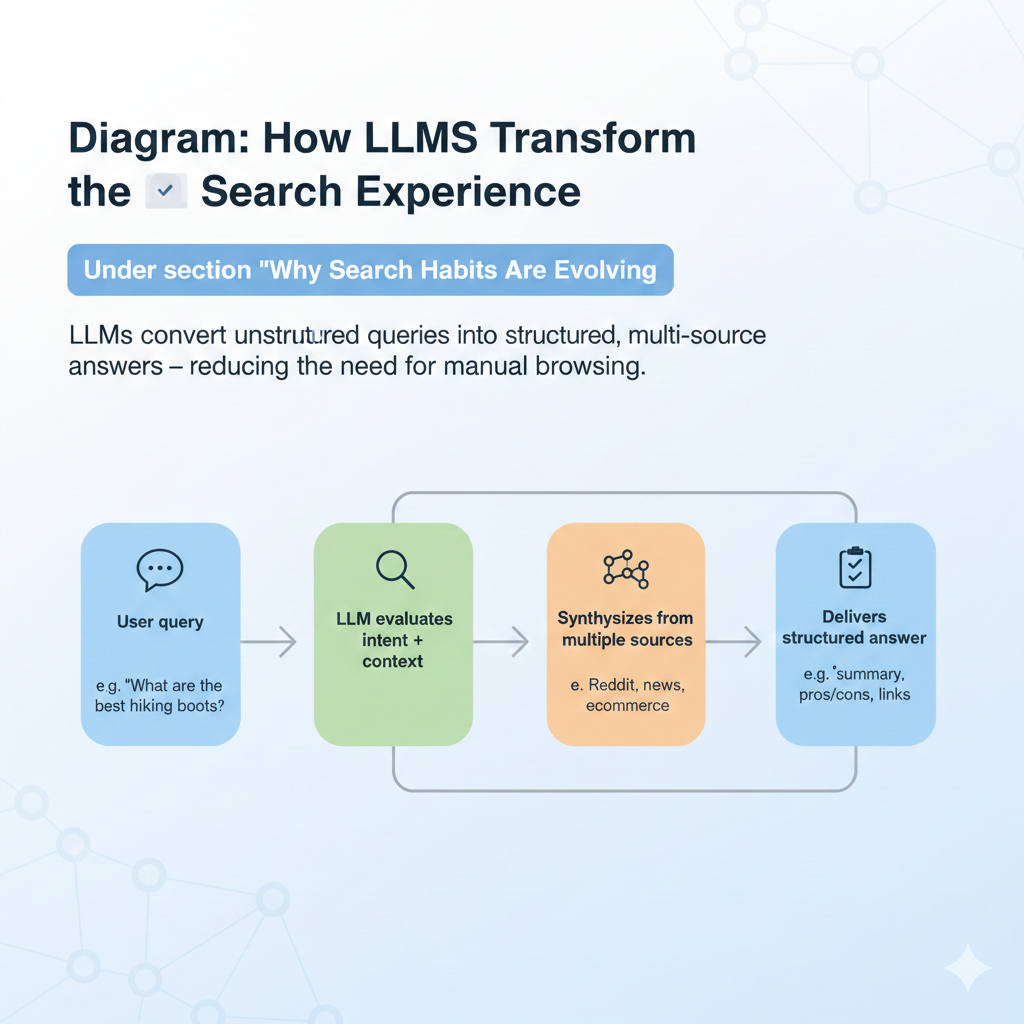
These shifts show how user habits are changing. Generative AI isn’t just a flashy new tool; it changes the very process of seeking information. For years, users developed routine habits (for example, “I always skip the ads” or “I always Google it”), but AI is creating new shortcuts around those routines.
In one study, users noted that AI greatly speeds up research by helping to define and articulate the query, fill knowledge gaps, and identify credible sources. An AI assistant can swiftly sift through mountains of data, scan long documents, and compare different perspectives on a topic, tasks that would take humans much longer.
Defining and articulating an information need
- Overcoming information gaps and fragmented keywords
- Weighing and selecting credible sources
- Scanning through enormous amounts of information
- Extracting key points from a long text
- Comparing different perspectives on a question
- Synthesizing and storing new knowledge
(Source: Nielsen Norman Group)
AI-powered overviews and chatbots now often appear at the top of search results. Every participant in NN/g’s study had encountered Google’s new AI-Overview feature on the search page.
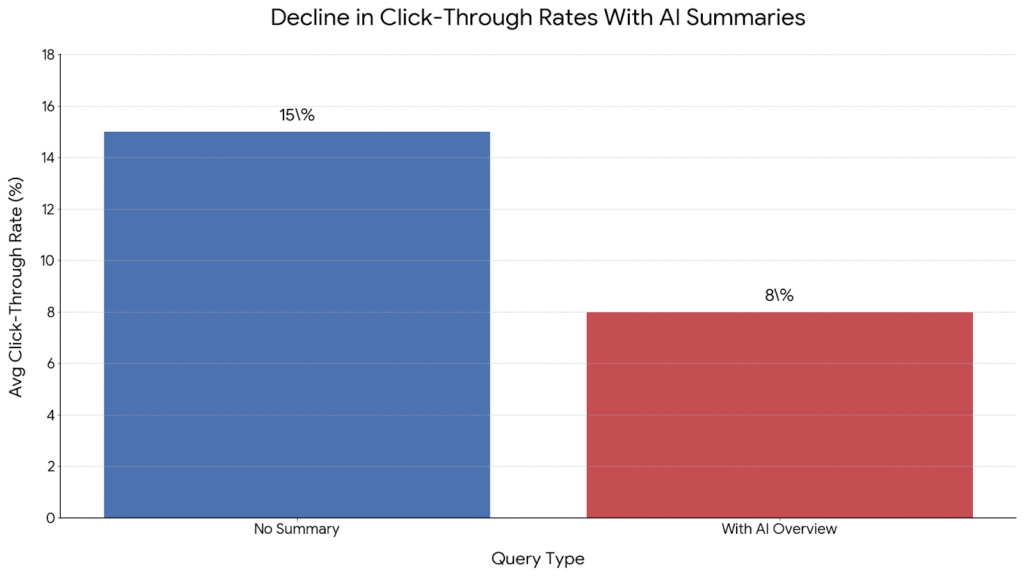
These LLM-driven summaries are designed to quickly answer the user’s question before clicking any link. In fact, a Pew Research analysis found that people who see an AI-generated summary are much less likely to click on the regular results links.
In practical terms, AI is doing the first pass of research, often satisfying the query immediately.
Impact on Search Traffic and Brands
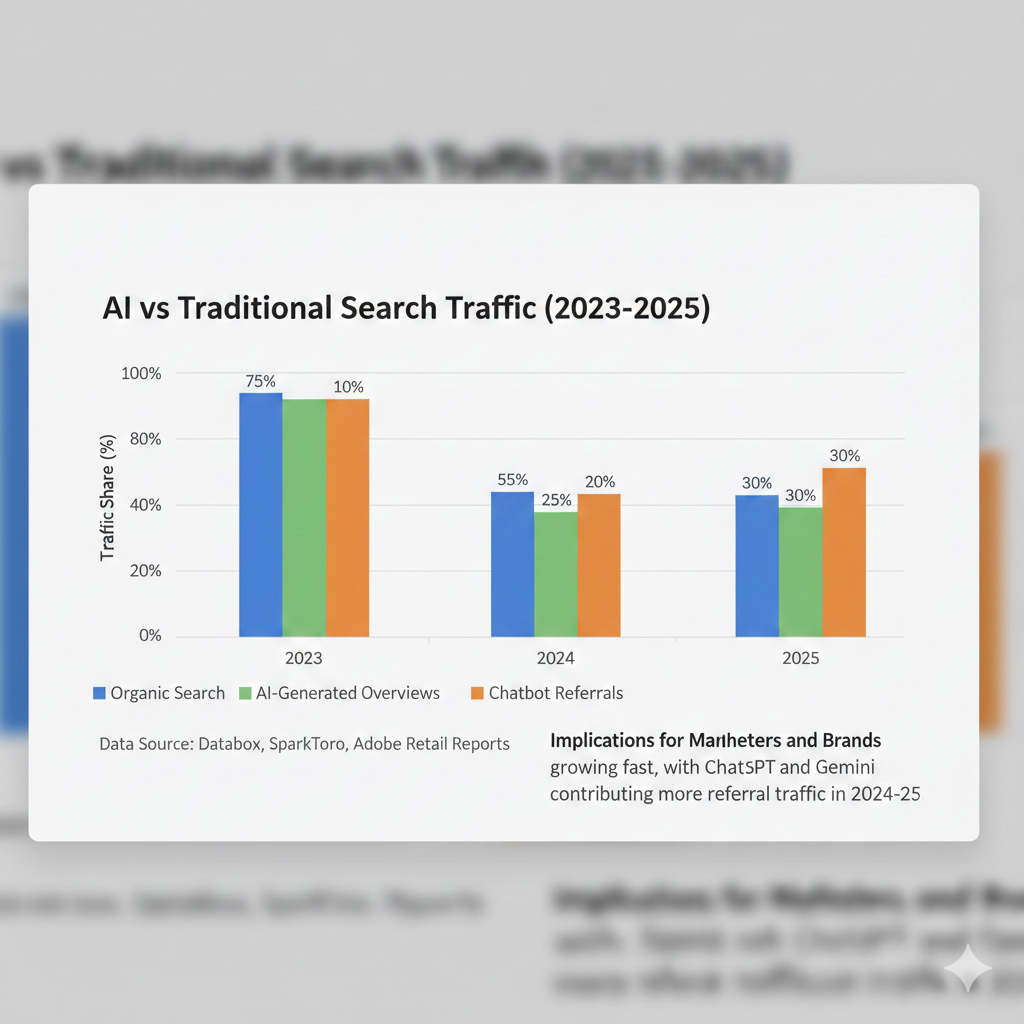
How is all this affecting websites and businesses? Early data offers clues. For example, a Databox survey found that 84% of website visits still come from classic SEO channels (vs ~16% from AI-driven search).
In other words, high-quality content and organic SEO still drive the vast majority of traffic today. Likewise, roughly 86% of conversions were attributed to traditional search sources versus only 14% from AI-driven answers. This means the tried-and-true content strategies still dominate the numbers, for now.
When marketers were asked which AI tool drives the most traffic to their sites, ChatGPT dominated: about 55% said ChatGPT, while others like Perplexity or Gemini accounted for only a few percent.
Even so, as AI chatbots improve and integrate with search engines, that balance could shift. Industry analysts predict ChatGPT alone might capture about 1% of total search queries by 2025.
Google itself remains the primary gateway for most queries. Digiday reports that Google’s market share only dipped below 90% in late 2024, with all AI-powered search engines together taking under 1%.
However, brands are already feeling the impact of AI on attention. A recent Bain & Dynata survey found 80% of users rely on AI summaries for at least 40% of their searches, leading to an estimated 15–25% drop in organic traffic for many content sites. Essentially, when a user’s question gets answered by an AI snippet, the site may lose that click.
From a marketing perspective, the message is clear: search is changing, and that requires new strategies. Meltwater warns that as LLMs replace traditional search, every prompt becomes a potential consumer touchpoint for your brand.
In other words, if your business isn’t visible to the AI tools (chatbots, overviews, answer engines), it’s missing those interactions. Even Google’s upcoming AI – Overviews will look for trusted sources, meaning if your site or brand isn’t on the radar, it won’t get cited.
Gartner predicts that by 2026, roughly 30% of brand perception will be shaped by generative AI answers. That puts a premium on being present and authoritative, not just highly ranked.
Shifting SEO Strategies
As search is changing, SEO experts are already adapting. The buzz term here is Generative Engine Optimization (GEO). Rather than only trying to rank traditionally, GEO focuses on being found and cited by AI models.
AI assistants tend to draw answers from sources they trust and understand. If your content isn’t marked up clearly or doesn’t contain recognized facts and snippets, it may be left out of those answers entirely.
Key tactics now include:
Structured Data & Clear Content: Use schema markup and maintain an organized site structure so that AI can easily parse your information.
Good Citations and Brand Mentions: Get your name mentioned on sites with a lot of authority, in news stories, directories, and through public relations. LLMs usually show businesses that have a lot of good reviews and references.
Conversational and Q&A Content: Make pages that answer common questions directly in the form of a Q&A or a lesson. These styles are often used in AI reports. You can make your content snippable by writing FAQs, how-to lists, or blog posts with a conversational tone.
Interactive and Engaging Content: Make tools, calculators, games, and other things that people can interact with. AI replies can quickly skip over simple informational pages that don’t add anything new. Users stay interested in interactive features, and search engines can use data other than plain text to index them.
As Ann Smarty (SEMRush) notes, SEO fundamentals like branding, co-citations and backlinks still matter. “We have been building brand signals, keyword optimization, and user experience,” she says. “That hasn’t changed; we’re just layering AI-awareness on top.”
Measuring Success in an AI Era
When the search is changing, our performance metrics change too. Instead of just rankings and click-through rates, companies now track AI-specific visibility. For example, Databox found that marketers gauge their GEO (Generative Engine Optimization) success by metrics like visibility in AI-generated overviews and increases in AI-driven traffic.
In practice, this might mean tracking whether your brand name or site appears in Google’s AI Overviews, or if ChatGPT gives your page as an answer. Those are the new equivalents of a position 0 in search.
Traditional engagement metrics still matter, but the focus shifts slightly. SEO specialists in Marketing Insider Group talk about measuring user intent satisfaction, essentially checking whether the content fully resolves the query, since AI can now assess that with advanced analytics.
In concrete terms, optimize for helpfulness: a page that comprehensively answers a question might see fewer clicks (if the AI answers it directly), but higher satisfaction scores and longer-term trust. Tools like Meltwater’s GenAI Lens can help brands see exactly how AI chatbots are describing them, letting you measure and respond if an AI answers are incomplete or inaccurate.
Adapting to the New Landscape
If nothing else, search is changing, and businesses must take notice. Here are some practical takeaways:
Diversify where you’re found. Strengthen your presence on social and niche platforms, not just Google. If 29% of young users prefer to search on social media, ensure your brand profiles and content there are up-to-date and keyword-optimized.
Use AI tools wisely. LLMs can speed up content creation and ideation, but always fact-check. According to Databox, ensuring factual accuracy is the top concern for AI content. So use AI to draft or brainstorm, but have humans verify.
Build trust signals. The more a brand is talked about in reliable sources, the higher the chance it will show up in AI answers.
Use AI-monitoring tools (like Meltwater’s GenAI Lens or even simply asking ChatGPT) to see what answers mention your products. If an AI tool gives a customer outdated or wrong info, quickly update your source content. The agility to iterate on answers in chat can be a new marketing advantage.
Even as AI grows, traditional SEO and user-centric content remain the foundation. As one SEO consultant put it, “We’re creating content and experiences for both humans and AI; the tactics are the same, we’re just changing how we measure success”.
The best strategy is to serve the user’s intent first and let the technology adapt around it.
Conclusion
At the end of the day, it’s impossible to ignore just how quickly our search habits are evolving. In fact, the pace of change right now is faster than anything we’ve seen in the last ten years.
With AI assistants and social platforms stepping in as our go-to sources for answers, every search feels more like a conversation than a simple query. The old type, click, and browse format is slowly fading, and search is changing in ways that reshape how people discover information.
The reassuring part? The core principles haven’t disappeared. Clear, helpful content still matters. Brand authority still matters. Technical foundations still matter. What’s shifting is the landscape around them.
And like every shift in digital behavior, this one comes with opportunity. If you understand how AI tools interpret questions and shape their answers, you can adjust your content and signals to show up everywhere your audience is looking: in chatbots, in search overviews, and in traditional SERPs.
Yes, the rules are changing. But the game isn’t over. It’s simply evolving, and the brands that choose to evolve with it will keep winning.
Excited to learn more? Keep following Blue Tangerine for the latest tech updates!