If you’ve ever opened a website on your phone and felt frustrated, text too small, buttons too close, menus hidden, pages slow, you already understand why mobile first website design matters. Now imagine the same situation in Dubai, a city where traffic is constant, lunch breaks are short, and almost every purchase decision starts on mobile.
In Dubai, where business moves quickly and attention spans are short, a website is often the first place someone forms an opinion about your brand. Many visitors don’t walk into a store first; they Google.
Here’s the actual picture:
Most people here browse while waiting for coffee. They book restaurants while in the car. They compare products during mall walks. They don’t sit at a desk to initiate interest; they start with their phones. If your business isn’t ready for that, conversions silently slip away.
And that’s exactly where the idea of building a mobile-first website design UAE and taking it further with localization, becomes a revenue decision, not just a design preference.
This article breaks down the real reasons mobile optimized website convert better in Dubai, how behavior and expectations here differ from global patterns, and what it takes to build a website that feels fast, intuitive, familiar and trustworthy to a UAE audience.
The Mobile Reality in the UAE: More Than a Trend, But A Habit

Let’s put some real numbers behind this.
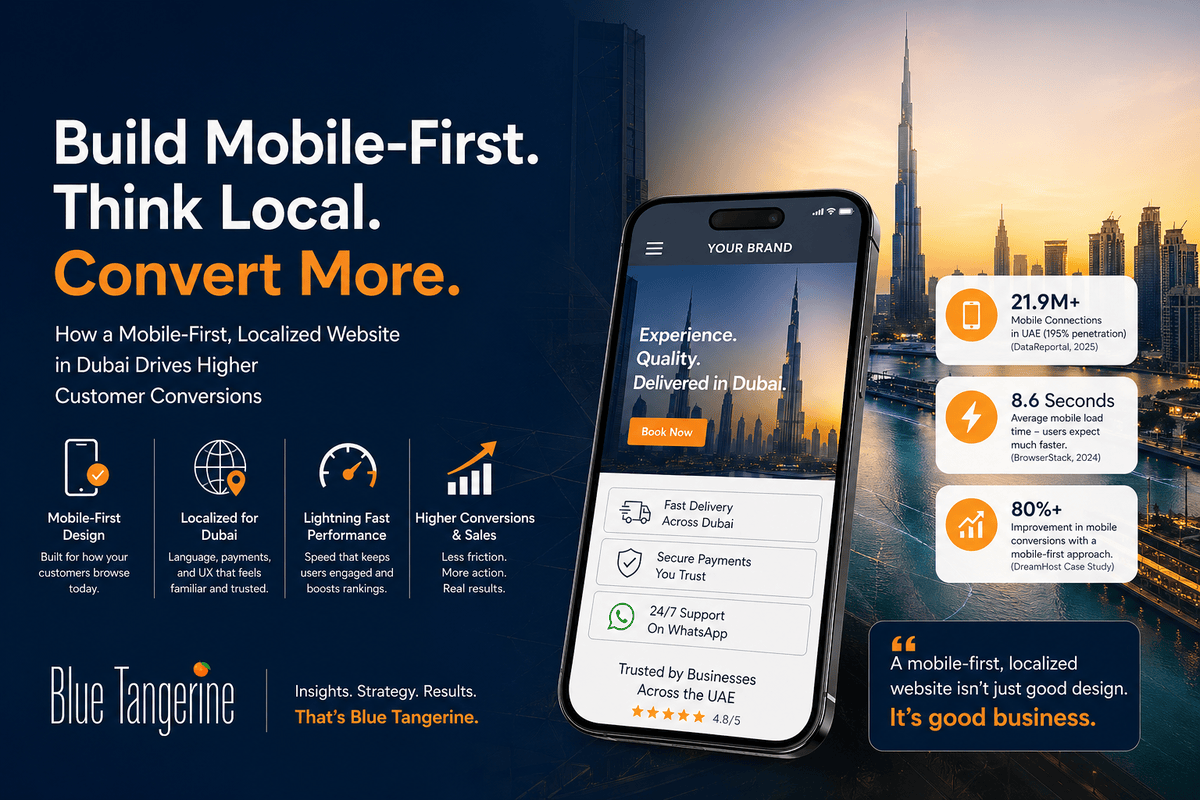
As of 2025, the UAE has more mobile connections than people, with over 21.9 million subscriptions, equating to a 195% penetration (DataReportal). That alone tells us something important:
People here don’t just use mobile phones; they depend on them.
Globally, mobile dominates web access, and the UAE mirrors that strongly. Platforms like HubSpot continue to highlight how mobile browsing has overtaken desktop in many industries, and more than half of online traffic now comes from mobile devices.
Dubai, specifically, is one of the most smartphone-dense environments in the world. People compare prices on their phones even when standing inside a store. They order groceries during a meeting break. They schedule clinics, salons and home services while watching Netflix.
But usage is only part of the story; expectation is the real driver.
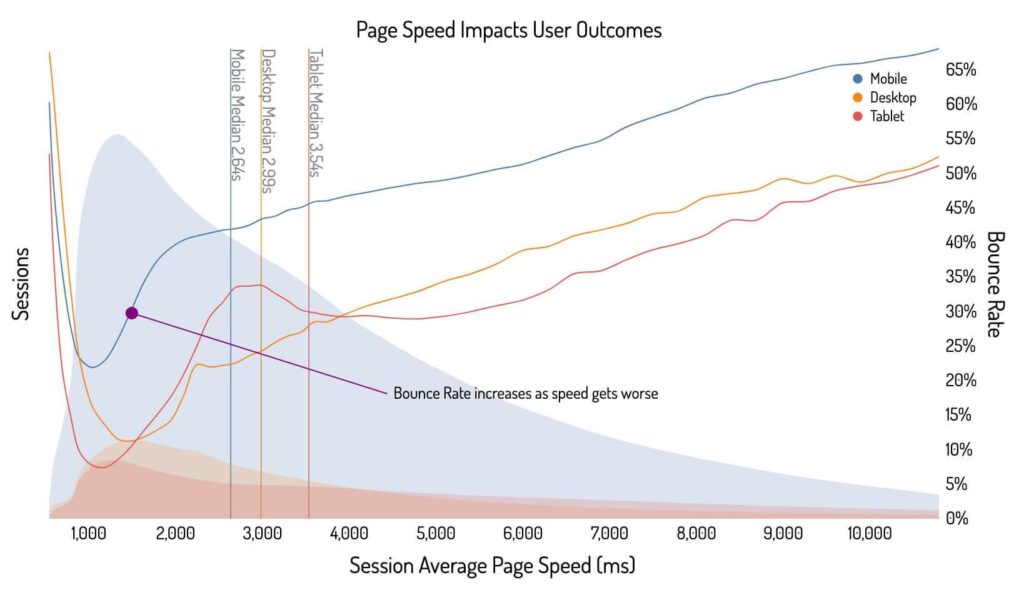
BrowserStack reports that average mobile load times globally hover around 8.6 seconds for many major sites, but modern users don’t wait that long. In a city like Dubai, where convenience competes with luxury, slow websites feel instantly replaceable.
Users here will not zoom. They will not pinch. They will not wait. If a page fails to load fast, or if navigation feels clunky, they exit; not later, not after thinking, they do it immediately.
And when a brand loses that moment, it often loses the conversion forever.
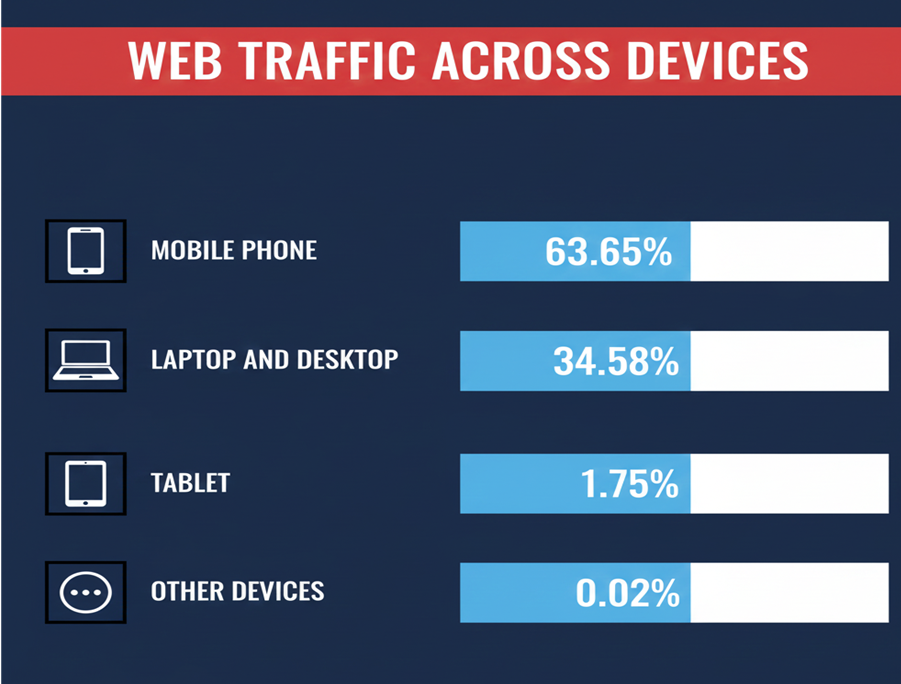
Note: Percentage of total web pages served to web browsers running on each kind of device
The Difference Between “Responsive” and Mobile Optimized Website
Responsive design is something many businesses believe they already have. But responsive is often desktop-first, built for a big screen and then shrunk down. A mobile-first website design UAE flips that thinking completely. Instead of scaling down, it scales up.
BrowserStack summarises this mindset clearly: mobile-first means prioritising the smallest screen, the least space, and the fastest interaction first.
A mobile-first site forces clarity. It strips out noise. It prioritizes messaging.
When the real estate is as small as a palm, the brand must decide what truly matters. Is it the product image? A booking button? A WhatsApp CTA? The offer?
From a UX perspective, mobile-first design creates benefits that desktop-first sites rarely achieve:
What Mobile-First Websites Tend To Do Better?
| Conversion Advantage | Why It Matters |
| Fewer distractions | Users focus on one clear path, usually the CTA |
| Touch-ready UI | Buttons are thumb-friendly, scroll-friendly, and fault-proof |
| Faster load speeds | Less code, compressed media, shorter rendering time |
| Better SEO | Google indexes mobile first |
| Higher conversion rate | Less friction turns more visitors into customers |
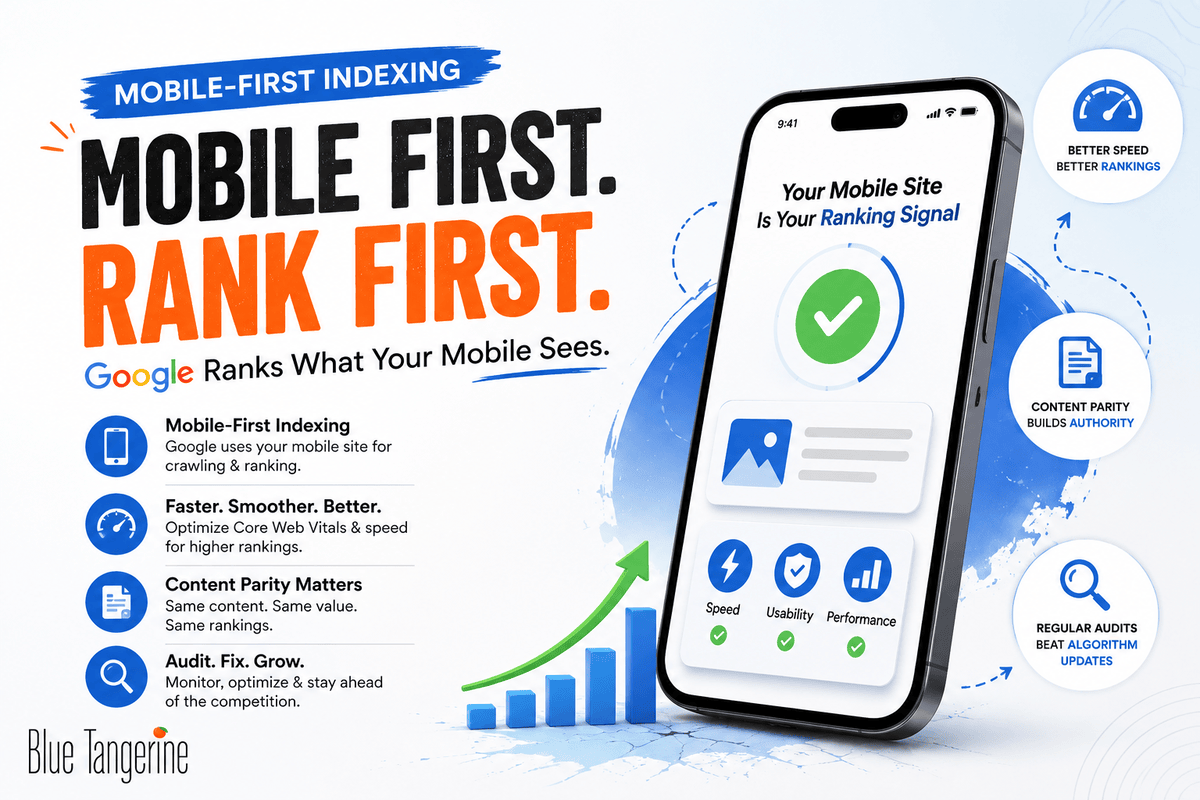
HubSpot and Google documentation both highlight the direct relationship between mobile optimized website and ranking performance; Google now indexes mobile versions before desktop by default.
So, in short, Mobile-first isn’t design, it is prioritization. And prioritization is what drives conversions.
Why Localization in Dubai Isn’t Optional, But A Must
Mobile optimization alone can improve engagement, but localization is what makes conversion stick. Dubai’s audience is diverse with multiple nationalities, dual language preferences, mixed payment behavior, and varied comfort levels with online transactions.
A global website template may “work,” but it often feels foreign. A user should not feel like the website was built for someone else.
What Localization Means in UAE Web UX:
-
- Language matters, and bilingual design matters even more
A bilingual layout with English first and Arabic support (wherever it’s necessary) increases comfort and helps users feel seen. As alignment and RTL also support signal cultural relevance.
-
- Payment behavior here is unique
UAE buyers often choose local payment gateways like Tabby, Tamara, and regional card processors. If a checkout forces other payment options, the sale will be lost.
-
- Trust signals
Local addresses, Dubai delivery timelines, VAT invoice clarity; these small things build credibility.
-
- Communication style is culturally specific
People in the UAE love fast, direct contact. Websites that integrate WhatsApp, click-to-call, or real-time chat outperform those that rely solely on forms.
Localization is not just translation. It’s actually an acknowledgement. When the user feels the website understands how they buy, not just what they buy, conversion follows naturally.
Did you know, speed equals conversions, and every second counts as money.
One of the clearest connections between design and revenue is page speed. BrowserStack reports how bounce probability rises dramatically with every additional second a mobile page takes to load.
DreamHost also documented a real example: before mobile optimization, a brand saw under 4% completion rate on mobile sign-ups. After redesigning with mobile-first principles, that number jumped above 80% for users who began the flow.
The numbers speak loudly, but the psychology is even louder. A fast site feels trustworthy. A slow site feels unsure. And uncertainty kills conversions.
What a High-Converting Mobile-First Dubai Website Actually Looks Like
Below is a real-world breakdown of what a strong mobile-friendly localized website delivers, step by step through the customer journey.
-
- Homepage: Immediate Clarity
A user should understand your value in less than five seconds.
-
- One clean headline
-
- One clear CTA (Buy / Book / Enquire)
-
- No clutter, no confusion, no scrolling needed
-
- Visible WhatsApp/contact action without effort
-
- Product or Service Page: Designed to Answer Questions, Not Create Them
A Dubai consumer wants information quickly on pricing, delivery, availability, and payment options.
Strong pages include:
-
- Compressed media (WebP recommended for mobile speed)
-
- Benefits-focused copy (not feature paragraphs)
-
- Local currency + delivery estimates
-
- “Order / Book Now” thumb-reachable
-
- Live chat or call option above the fold
3. Checkout Flow Should Be Short, Familiar, Frictionless
Fewer fields lead to more checkout completions. If the checkout options are bad, that leads to abandoned carts.
-
- Address autofill
-
- Multiple payment methods
-
- No mandatory account creation
-
- One-page checkout if possible
-
- Post-Purchase UX: Small Touches Build Loyalty
This is where brand perception strengthens:
-
- Clear Dubai-specific delivery times
-
- Simple reschedule or cancel path
-
- Mobile-friendly emails and WhatsApp confirmations
-
- Retention often begins after the transaction
Why Many Dubai Websites Still Underperform
Most underperforming sites are not broken. They are simply built backwards. Desktop first. Template first. Developer first. But the user is mobile-first, and that is where the disconnection uproots.
Typical mistakes include:
| Underperformance Trigger | Why It Hurts Conversion |
| Heavy homepage sliders | Slow loading, low relevance to mobile users |
| Small touch buttons | User becomes frustrated as the buttons are hard to click |
| No local cues | Feels foreign and less trustworthy |
| Global payment gateways only | Local audience abandons checkout |
| Long forms with tiny fields | Leads drop off as it’s time-consuming |
Dubai is a high-expectation market. A global theme does not equal a local experience. The opportunity is not in doing what everyone does, but doing what feels native to your audience.
A Practical Mobile-First Website Checklist Built for UAE Brands
Use this as a real working audit outline:
-
- Start design thinking from a 375px screen first
If it fits there, it fits everywhere. - Buttons minimum ~44px (thumb-friendly)
Small buttons lead to accidental clicks, and eventually a conversion drop-off - Speed-first development decisions
Enhance with WebP, minified CSS/JS, lazy-load images, caching + CDN - Dual-language support if the audience requires it
Not just a translation, but a thoughtful bilingual UX wherever it’s needed - Payment options your audience trusts
Incorporate Tabby, Tamara, card, Apple Pay, or other UAE gateways that the audience trusts, instead of global platforms - Contact made frictionless
WhatsApp instead of a form and Click-to-Call without a hidden number - Monitor real numbers
Bounce rate, scroll depth, mobile conversions, and page load
- Start design thinking from a 375px screen first
This isn’t theoretical. It’s practical, measurable and most importantly, it works.
Why This Approach Drives Real, Measurable Conversions
When a brand transitions from a desktop-first, template website to a mobile-first, locally-aware site, measurable improvements often appear in the first weeks:.
-
- Reduced bounce rate
-
- Increased add-to-cart sessions
-
- Higher lead form submissions
-
- Faster checkout completion
-
- Better ad ROI due to better landing page quality
DreamHost reports mobile conversion improvements exceeding 80% when the UX flow is simplified and optimized.
Even if your industry isn’t e-commerce, and it falls under service, real estate, hospitality, clinics, or consulting, the logic remains the same. Less friction brings more action. Mobile-first design doesn’t just create beautiful visuals. It creates predictable revenue.
If You Want a Website That Doesn’t Just Display, But Converts
A website shouldn’t just look good. It should perform, sell, and convert.
Blue Tangerine builds websites for that exact outcome, especially for fast-growing Dubai brands that want more than a digital brochure.
We create mobile-first website designs, optimized for speed, built for localized UX design Dubai experiences.
We integrate WhatsApp, regional payment gateways, VAT cues, delivery logic, and crucially, we build with conversion psychology in mind, not just templates.
If you want your website to be a mobile-friendly localized website that generates leads, bookings, revenue, and repeat customers, we’ll help you get there.
Contact us today!