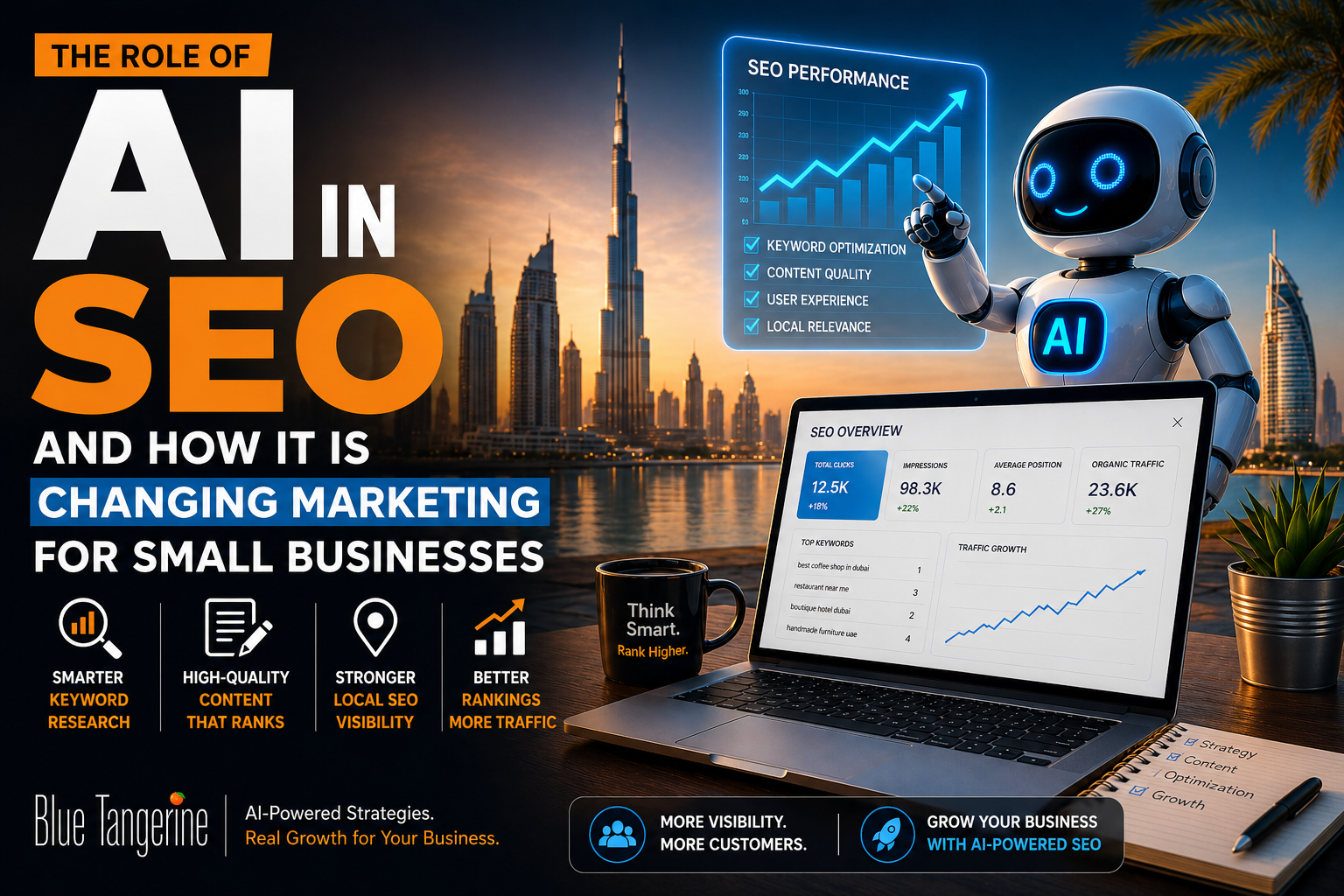
What is AI in SEO and how AI is changing marketing for small businesses?
Using AI to enhance search optimisation is what “AI” in SEO stands for. In real life, this means that tools driven by AI can analyse your website, suggest better keywords, and even generate outlines for large amounts of content.
AI algorithms (RankBrain, BERT, and MUM) are now used by search engines like Google to figure out what people really want when they look, and how AI will affect SEO. AI tools automate the tedious aspects of SEO, such as keyword research, competitor analysis, site audits, etc., allowing you to concentrate on strategy.
This change is already impacting local companies and resonates with how AI is changing marketing. As stated by an article by Neil Patel, marketers who control their niches will learn how to use AI in SEO. People who don’t will have lower rankings.
Search Engine Land agrees that search engines today credit content that is clear, well-structured, and semantically rich, not just pages that are full of keywords.
This implies that achieving online visibility depends on more than just traditional ranking factors. It also depends on how well AI systems can understand and link to your content.
That means more than just trying to get the #1 link on Google for a local shop or restaurant. It means writing material that AI can easily pull into voice assistants or chatbots.

These days, local businesses need to see their business as a live component, not just a listing that doesn’t change. Google and other AI-powered search engines examine factors like your actual business hours, how quickly you respond to customer service requests, and how you act in real life.
So, terms aren’t the only thing that local SEO is about; how AI is transforming SEO. AI might give your restaurant a better ranking if it knows that you always answer the phone, answer messages quickly, or post updates at the right time.
In short, AI in SEO takes the best parts of traditional optimisation and adds an understanding of real business signals.
How AI is transforming SEO and how AI will affect SEO in local search
AI has changed the way SEO is done, and how AI will affect SEO. Non-click search is one of the most significant changes. Many questions now end with an AI-generated answer box instead of a click to a website.
As of early 2025, these AI results showed up on about 13% of all Google searches. This means that if you’re a local business, you need to optimise so that you are picked as the best answer, not just to rank on page one. It must be simple to read for AI to be able to pull out and quote your content. Headings, short lines, and bullet points should all be easy to read.
How AI will affect SEO rankings through E-E-A-T and high-quality content
Quality and skill are also crucial to AI. Neil Patel asserts that AI in marketing has elevated the standard for content quality, despite its ability to speed up and reduce the cost of content creation. General information gets pushed to the bottom of the page, while truly useful first-hand knowledge stands out.
Google’s algorithms are now looking for signs of Experience, Expertise, Authoritativeness, and Trustworthiness (E–E–A–T). A local business might share interesting case studies, stories about happy customers, or step-by-step instructions for how to do something in real life. Anything that shows they know what they’re talking about. Experts say that when new content appears on top-ranked pages, it means the authors really know what they’re talking about and have new ideas.
Now, local SEO is less about putting keywords all over the page and more about being a well-known expert and being seen in the area. AI has changed that, which is why. This new way of thinking is called the Local Entity Model (LEM).
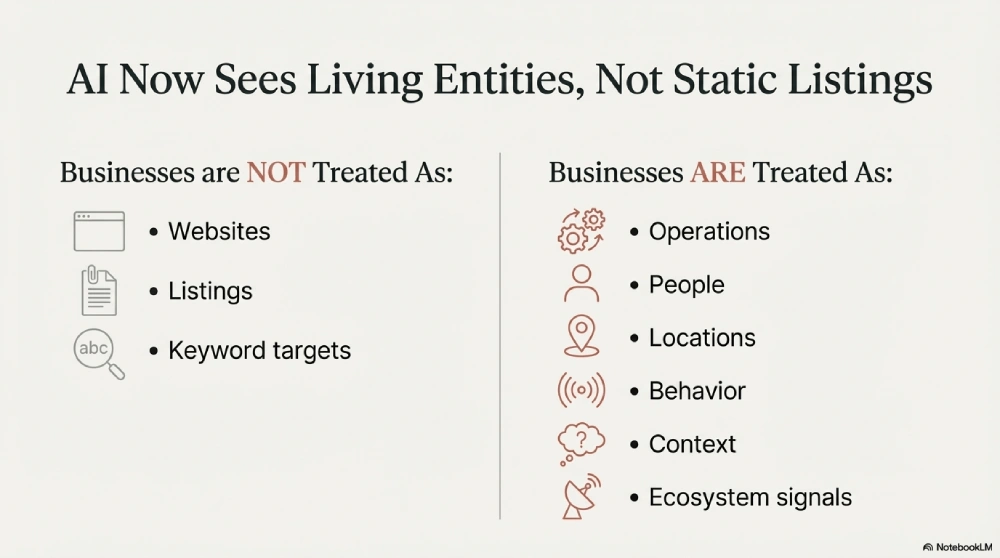
AI doesn’t just see a list of keywords on a web page. It sees your business as a living thing with people, places, processes, behavior, and context. This idea says that ranking is more than just matching a word or a page.
How can AI be used for SEO to improve small business performance
Small businesses can benefit from AI tools because they can handle boring chores and speed up the content creation process.
How is AI taking over SEO workflows through automation and tools
Here are some useful steps and tools to consider:
Automated keyword research: Modern AI platforms like Ubersuggest, Ahrefs, and SEMrush can quickly look at thousands of different keyword variations and find hidden local business possibilities.
Creating material with AI: Generative AI (like ChatGPT, Jasper, Claude, etc.) can quickly write out blog post outlines, meta descriptions, or social posts. You could tell ChatGPT, “Write a friendly 200-word blog intro about Emirati street foods,” and it would give you a good copy right away. As experts say, make the material unique by combining AI’s speed with your knowledge.
Content optimisation tools: SurferSEO, Clearscope, and Frase are AI-powered SEO helpers that look at pages that are already ranking well and suggest changes that can be made right away. As you write, these tools can suggest keywords that are linked, the best length for your content, the best way to structure your headings, and topics that you might be missing.
AI expedites the process of conducting comprehensive SEO audits by small teams. Your whole site can be crawled by tools like Ahrefs, SEMrush, or Screaming Frog, which will then find broken links, duplicate pages, missing meta tags, slow pages, and schema mistakes.
AI can examine numerous competitor sites to determine their effective strategies. It can show you the most popular keywords people use to find your rivals’ websites, find content gaps, and investigate how to link back to them.
Voice and area search optimisation: Make sure that text and voice searches can find your information easily. Bots like Siri, Alexa, and Google Assistant use conversational search a lot. Make sure your website can answer questions that people often ask.
Businesses in the area can do better work if they use all of these tips and tools together. You’ll spend less time on research and administration, and your content will be better, more AI-friendly, and stand out. Remember that AI can help you, but it can’t replace human intelligence.
How does AI affect marketing for restaurants, hotels, and shops in my area?
Aside from SEO, AI is also changing local marketing in big ways, and these changes often have something to do with search. AI also makes personalisation possible in shopping and food services.
Think about a restaurant that uses AI chatbots to take orders or suggest foods based on what other customers have liked. Consider a small shop that employs machine learning to display relevant products in real-time.
AI in SEO marketing lets local companies tailor their reach on a large scale, whether it’s through targeted ads, dynamic pricing, or chat support 24 hours a day, 7 days a week.
All of this personalised marketing content, like reviews, social posts, location pages, and more, comes back in search, which is good for SEO. AI algorithms will crawl and rank all of this content.
Is AI going to replace SEO or reshape the future of search?
From now on, AI will play an even bigger part in how AI will affect SEO. There is already a change from finding documents to understanding what they mean. Businesses in your area will need to be in both blue links and Google’s newest creative features to be found.
In other words, SEO will soon focus on being visible to AI systems. Generative Engine Optimisation (GEO) is a new idea that talks about making materials better so AI systems can choose them and use them in their answers, rewriting how AI is transforming SEO.
You don’t just want your page to rank #1 for the search term “best falafel near me”; you also want it to be included in ChatGPT’s response to the question “Where should I eat falafel in Abu Dhabi?” or in Google’s featured snippet. “
You also want it to be in ChatGPT’s answer to “Where should I eat falafel in Abu Dhabi?” or in Google’s featured quote. That requires information that is clear and trustworthy and that AI can rely on.
AI tools can make a lot of content, so to stand out, you need to offer something unique, reinventing how AI is changing marketing competition. E-E-A-T is a big deal for Google’s AI. It stands for things like firsthand experience and original study.
In other words, your company’s real insights-driven content will outperform AI-generated text in search results. Writing short comments for chatbots, adding structured schema to help AI understand your information, and checking facts and author credentials twice are some of the best things you can do in the future.
Writing short notes for chatbots, adding structured schema to help AI understand your information, and double-checking facts and author credentials are some of the best things you can do in the future. Businesses that do well will focus on becoming trusted local experts whose information is easy for AI to pull.
Local food and drink, travel, retail, and consumer goods businesses can stay ahead by investing now in AI-friendly content (clear structure, human expertise, localised information) and useful AI tools. People who do this will show up higher in both regular search results and the new answer features driven by AI.
Is SEO dead or evolving in 2026 with the rise of AI technologies
Finally, keep in mind that AI is only a tool and not a support. Always look over and change any content that AI made. Your style, your knowledge, and how you treat customers are all things that will set you apart.
Do you need assistance to perform AI in SEO? Let Blue Tangerine experts help you!