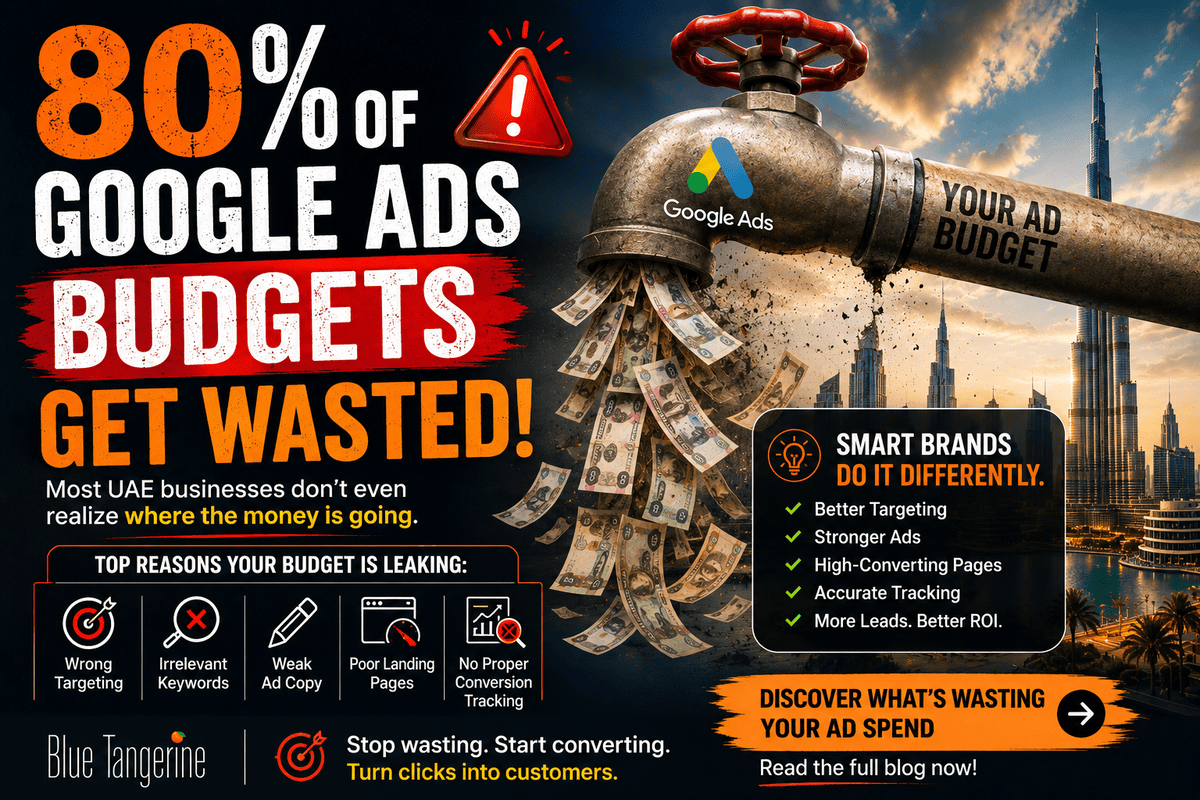
When businesses in the UAE struggle to get results from paid search, the problem usually is not Google Ads itself. More often, it comes down to common Google Ads mistakes that seem small at first but end up draining budget over time.
In a place like the UAE, where almost everyone uses the internet and mobile devices a lot, even small problems with a campaign can quickly become costly inefficiencies. According to DataReportal, 99.0% of people in the UAE were using the internet in early 2025. This shows how busy and competitive the digital world has become.
That matters because the UAE is not a passive market. It is fast-moving, highly connected, and full of users who compare options quickly before deciding where to click, call, or buy. Google and Visa’s regional research also highlights clear spikes in search and spending around major shopping and seasonal moments in the UAE, which means advertisers who run generic campaigns all year round often lose efficiency when demand shifts.
When people ask why so many Google Ads campaigns underperform here, the answer is usually much simpler than they expect. It is not always about the platform being too expensive.
It is often about strategy, structure, relevance, and measurement. The brands that waste money tend to launch campaigns quickly and hope traffic will solve everything. The brands that win take a far more disciplined approach.
Google ads mistakes that quietly waste budget
A lot of google ads mistakes do not look dramatic inside the account. The campaign may be live. The ads may be getting impressions. Clicks may even be coming in consistently. But behind the scenes, the budget is leaking through poor keyword choices, weak targeting, irrelevant landing pages, and incomplete tracking.
That is where most businesses get frustrated. They assume activity means progress. But paid traffic only becomes valuable when it turns into real business outcomes such as calls, lead form submissions, store visits, bookings, or sales.
Google’s own conversion measurement guidance makes it clear that advertisers should track not just website actions, but also phone call conversions and offline conversions where relevant. Without that, it becomes difficult to judge what is actually working.
This is also why many campaigns appear busy but still feel disappointing. The account may be optimized for clicks, while the business actually needs qualified leads. That gap between platform performance and business performance is where a lot of ad spend gets wasted.
Common Google Ads mistakes in keyword targeting
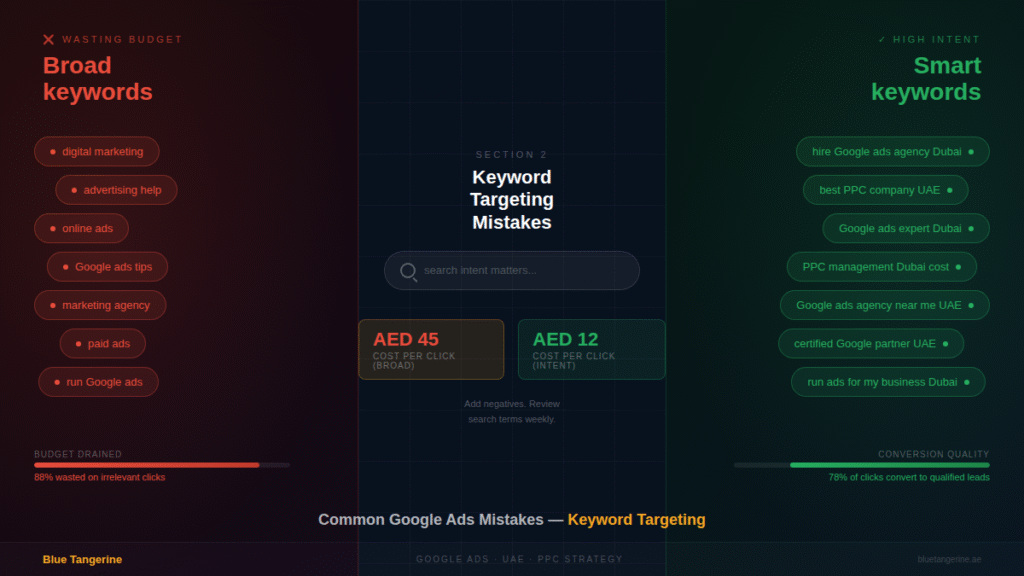
One of the biggest common Google Ads mistakes is poor keyword targeting. Many advertisers assume that if a keyword has volume, it must be valuable. That is rarely true. High-volume keywords often attract broad audiences, low-intent searches, or people who are still researching rather than ready to take action.
In the UAE, that problem becomes more expensive because digital competition is strong. If your ads are appearing for vague or weak-intent searches, the budget disappears faster without bringing the right visitors to your site. That is why smart advertisers focus less on getting more traffic and more on attracting the right traffic.
Google’s search terms guidance is especially relevant here. It advises advertisers to review actual search queries and add irrelevant ones as negative keywords so ads do not keep showing for searches that are not a good fit. In simple terms, if a user is looking for something you do not sell, your ad should stop appearing for that query.
A few of the most damaging keyword-related issues include:
- Targeting broad terms without enough intent filtering
- Failing to review the search terms report regularly
- Not using negative keywords to cut irrelevant traffic
- Mixing awareness keywords and conversion keywords in the same ad groups
This is one of the most important common Google Ads mistakes to avoid, because keyword waste builds slowly and silently. A campaign can lose money for weeks before anyone notices the pattern clearly enough.
Google ads mistakes beginners make early on
A lot of google ads mistakes start at beginner level. Businesses new to PPC often launch with one campaign, one landing page, a handful of broad keywords, and generic ad copy that could apply to almost any company.
It feels efficient at the start, but in practice it weakens relevance across the entire account.
This is why common mistakes beginners make in Google Ads tend to follow the same pattern. They are not always technical problems. They are usually judgment problems.
New advertisers often target too widely, write headlines that are too generic, and ignore how important message matching really is between the keyword, the ad, and the landing page.
Google’s explanation of Quality Score makes this very clear. It is influenced by expected clickthrough rate, ad relevance, and landing page experience. In other words, Google is actively rewarding advertisers who create tighter alignment between what the user searched, what the ad promises, and what the landing page delivers.
If someone searches for a specific service in Dubai and lands on a vague homepage with no clear next step, the campaign loses momentum immediately. Even if the click is cheap, it is still wasted if the page does not convert.
Common Google Ads mistakes to avoid in ad copy
Another area where advertisers struggle is messaging. This is where common Google Ads mistakes to avoid become more about communication than settings.
Too many ads sound bland, repetitive, or overly broad. They mention services without showing value. They chase visibility without giving people a strong reason to click.
In a competitive UAE market, that is a problem. Search users make quick decisions. If your ad does not speak clearly to their intent, urgency, or need, they will move on.
Google recommends using responsive search ads and improving ad strength, and it specifically notes that advertisers who improve Ad Strength from Poor to Excellent see 12% more conversions on average.
Responsive search ads are also designed to help advertisers compete in more auctions and capture more relevant clicks and conversions.
That is why strong brands write ads that feel specific. They mention the offer clearly. They reflect the service being searched. They avoid empty phrases and give the user a stronger reason to act now rather than later.
What are some common mistakes to avoid in Google Ads
When business owners ask what are some common mistakes to avoid in Google Ads, they are usually looking for one big answer. In reality, it is a combination of connected problems.
The most common ones are failing to track the right conversions, targeting broad keyword groups with no search-term cleanup, writing generic ads, and sending visitors to landing pages that do not match the original search intent.
These issues rarely exist alone. They usually reinforce each other. Weak keywords lead to weak clicks. Weak ads reduce relevance. Weak landing pages reduce conversion rate. Poor tracking hides the damage.
This is where many common Google Ads mistakes become harder to spot. The campaign is technically active, but strategically weak.
Blue Tangerine’s own PPC service pages emphasize performance tracking, campaign optimization, and tailored PPC strategy rather than simply buying traffic, which is exactly the difference that matters here.
Our Pay Per Click Advertising and PPC strategy content both focus on generating customers and maximizing ROI instead of just increasing click volume.
Why landing pages matter more than most brands think
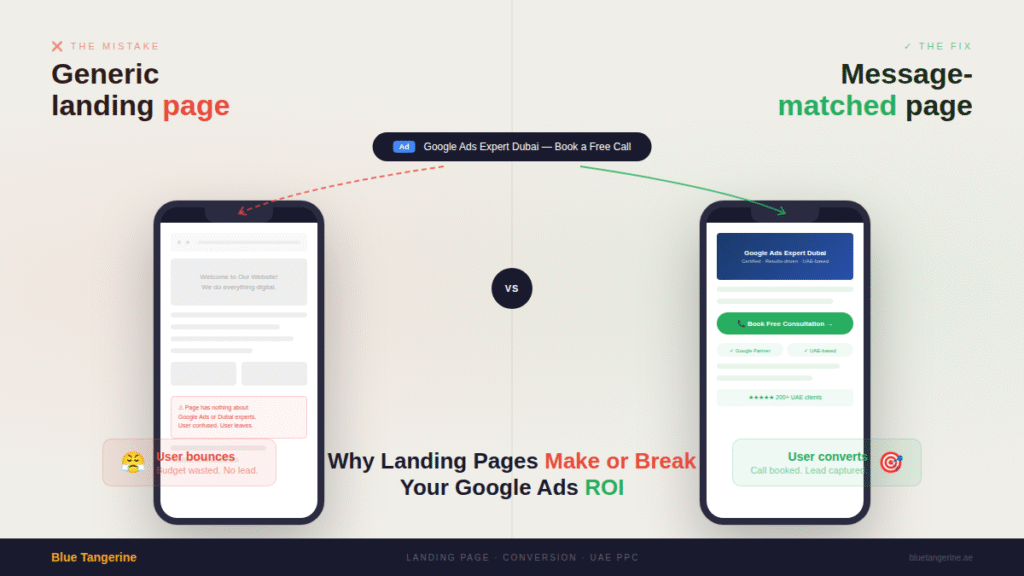
A surprising number of advertisers still treat the landing page as a secondary step. They spend time on keywords and bids, then send visitors to a page that feels generic, cluttered, slow, or disconnected from the ad.
That is one of the costliest common Google Ads mistakes because the landing page is where the money is either recovered or wasted. If the user clicks with high intent but lands on a page that feels confusing or unrelated, the conversion opportunity disappears instantly.
Google directly includes landing page experience as one of the three components behind Quality Score. A page that is relevant and useful helps support better performance. A page that is slow, vague, or poorly matched makes the campaign less efficient.
For UAE advertisers, this matters even more because the audience is strongly mobile-oriented. People compare quickly, scroll quickly, and leave quickly when the page does not feel clear. A strong landing page should continue the exact promise of the ad, make the offer obvious, and reduce friction around the next step.
How to avoid budget wastage in pay per click advertising
If the goal is to reduce waste, the answer is not always to spend less. The smarter move is to manage spending with more control. When people ask how to avoid budget wastage in pay per click advertising, the best answer is to improve relevance at every step.
That means better keyword intent, better ad copy, better location targeting, better landing page experience, and much better tracking. It also means understanding the local market instead of running a copy-paste campaign that could belong anywhere in the world.
In the UAE, demand changes around key commercial periods. Google and Visa’s regional commerce insights point to clear peak moments such as Ramadan, Eid, back-to-school, and major sale periods. Brands that plan campaigns around those demand shifts are in a much stronger position than brands that leave the same settings untouched throughout the year.
Here is what smarter brands usually do differently:
- They separate awareness keywords from conversion keywords
- They track leads, calls, and offline sales more accurately
- They align ads closely with landing pages
- They adjust campaigns around local seasonality and buying intent
- That is the real difference between activity and strategy
The most common mistakes businesses make in online ads
When looking at the most common mistakes businesses make in setting up online ad campaigns, one theme shows up again and again: businesses build campaigns around the platform, not the customer.
They get caught up in campaign settings, daily budgets, and keyword lists, but forget to ask bigger questions. What exactly is the user trying to do? What stage of intent are they in? What would make this click valuable to the business? What page should they land on? What counts as a conversion? What should be excluded?
These are the questions that separate high-performing campaigns from average ones. Without them, even experienced advertisers can fall into google ads mistakes that quietly push cost up and conversion rates down.
This is also where Blue Tangerine’s related content becomes useful as an internal reading path. Our PPC Marketing Funnel guide explains how paid traffic should support the wider customer journey, while our broader expertise pages show that PPC works best when it is connected to a full digital strategy.
What smart brands in the UAE do instead
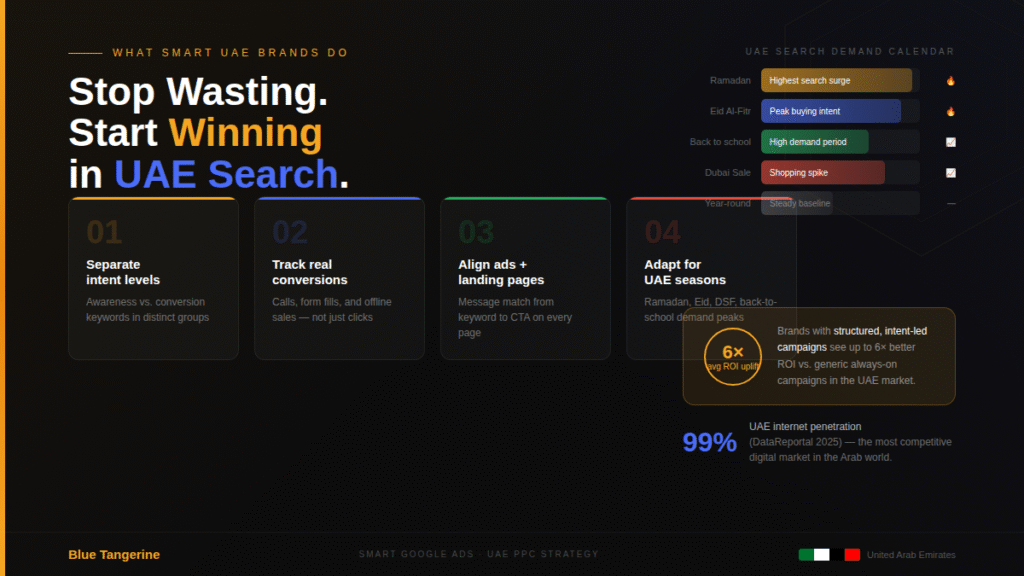
Smart brands do not treat Google Ads like a plug-and-play channel. They treat it like an evolving performance system.
First, they define success clearly. They know whether they want booked consultations, online orders, quality calls, showroom visits, or qualified form leads. Then they build campaigns around that outcome instead of optimizing for surface-level traffic.
Second, they structure campaigns with more discipline. They separate keywords by intent. They keep ad groups tighter. They review search terms. They improve ad strength. They refine landing pages. They measure what happens after the click. Google’s documentation on responsive search ads, search terms, and conversion measurement all support this kind of hands-on optimization approach.
Third, they respect local behaviour. They know the UAE audience is digitally active, mobile-heavy, and responsive to seasonal shifts. They do not assume the same messaging or structure will work equally well all year long. They adapt.
That is why common Google Ads mistakes to avoid are not just technical lessons. They are strategic habits. Smart brands replace those habits with sharper targeting, cleaner measurement, and stronger customer journeys.
Where Blue Tangerine fits into that picture
For UAE brands trying to improve ROI from paid search, the goal is not just to run Google Ads. The goal is to run them with more clarity and less waste.
Blue Tangerine’s PPC pages are all about attracting new customers, crafting a tailored strategy for each client, and enhancing the pages over time rather than just boosting traffic.
Our Pay Per Click Advertising service, PPC strategy content, and PPC funnel blog all share a common theme: structured campaigns that continuously improve are far more effective than those that are just set and forgotten.
So if your campaigns are getting clicks but not enough real business value, the next step is not guessing harder. It is auditing the account properly, fixing the weak points, and rebuilding around relevance and conversion quality.
Conclusion
The real reason so many Google Ads budgets get wasted in the UAE is not because the platform lacks potential. It is because too many campaigns are built on weak foundations.
The most expensive issues are often the most ordinary ones: broad targeting, poor keyword control, generic ad copy, weak landing pages, and incomplete tracking. Those are the common Google Ads mistakes that quietly reduce performance month after month.
The brands that get stronger results do not rely on luck. They make smarter decisions at every stage of the campaign. They understand intent better. They track what matters. They tighten structure. They improve relevance. And they adapt to how people in the UAE actually search and buy.
If your paid search campaigns are active but underwhelming, now is the time to stop funding avoidable waste and start building a Google Ads strategy that works harder for every dirham.
Ready to turn wasted clicks into qualified leads? Blue Tangerine helps UAE brands build sharper, better-optimized Google Ads campaigns designed around real growth, not vanity metrics.
FAQs
-
What are some common mistakes to avoid in Google Ads?
Some of the common pitfalls include broad keyword targeting, weak conversion tracking, irrelevant landing pages, generic ad copy, and not utilising negative keywords. These issues can make things less relevant and lead to budget waste over time. Google suggests utilising search terms reports, responsive search ads, and accurate conversion measurement to enhance performance.
-
What are the common mistakes beginners make in Google Ads?
Beginners often target too broadly, send all traffic to one page, ignore search intent, and judge success mainly by clicks. These early mistakes weaken ad relevance and reduce the chance of getting real conversions. Google’s Quality Score guidance shows how ad relevance and landing page experience directly affect performance.
-
How can businesses avoid budget wastage in pay per click advertising?
By separating high-intent keywords from research terms, reviewing search terms regularly, adding negative keywords, improving landing pages, and keeping track of real conversions like calls, leads, and offline sales, businesses can cut down on waste.
-
Why do Google Ads campaigns need a different approach in the UAE?
The UAE is a highly connected market with 99.0% internet penetration, strong mobile behaviour, and clear seasonal demand spikes. That means campaigns need tighter targeting, better relevance, and more active optimization to stay efficient.
-
What do smart brands do differently with Google Ads?
Smart brands focus on business outcomes instead of vanity metrics. They build tighter campaign structures, improve ad strength, refine landing pages, track conversions properly, and adjust campaigns around real audience behaviour and market peaks. Blue Tangerine’s PPC and strategy resources reflect this more performance-led approach.