Every year, as Ramadan approaches, something quietly shifts in the UAE’s retail landscape. Malls get busier, social media feeds fill with outfit inspiration, and consumers start making very intentional decisions about what they’re going to wear for Eid.
If you’re a brand trying to understand what’s happening and, more importantly, what to do about it, this guide is for you.
We’ve broken it down into the questions that actually matter.
What are the latest Eid shopping trends in the UAE?
This is probably the most common question brands ask, and the honest answer is: it’s changed quite a bit in recent years.
The biggest shift is that shopping has become far more intentional. UAE consumers, specifically women shopping for modest fashion, are no longer impulse buyers. They’re researching weeks in advance, watching creators they trust on Instagram and TikTok, reading reviews, and arriving at stores (or checkout pages) with a clear idea of what they want.
On the spending side, the numbers are hard to ignore. During Eid Al Adha 2024, online orders across the MENA region rose by 5 per cent compared to non-holiday periods, while gross merchandise value grew by 14 per cent. The average order value climbed from $37 to $40, a meaningful signal that people are spending more per purchase, not just more often.
In the UAE specifically, shoppers posted an average order value of $61 during the Eid period, making it one of the top-performing markets in the region alongside Saudi Arabia.
And it’s not slowing down. Research projecting ahead to Eid Al Adha 2025 forecasts a 10 per cent rise in e-commerce orders and a 14–15 per cent growth in gross merchandise volume. For fashion brands specifically, this is prime time.
(Source: Khaleeji Times)
What are the latest modest fashion styles for Eid celebrations in the UAE?
If you haven’t updated your buying strategy in the last couple of seasons, here’s where things stand.
The dominant pieces this Eid season are flowing kaftans, embellished abayas, cape-style dresses, and coordinated sets. But the way they’re being styled and chosen has evolved.
Many women now make sure they have a variety of clothes they can wear in different ways over the three days of Eid, rather than relying on a single big store. That’s a big shift in how people shop, so stores should focus on groups of items instead of just one hero item.
In terms of specific design direction, modern Eid fashion features velvet kaftans, minimal embroidery, cape-style silhouettes, monochrome sets, tonal layering, and elegant fabrics styled with contemporary accessories.
Colour-wise, the Eid 2026 palette is soft, refined, and timeless. Loud neons and overly bright shades take a step back, replaced by colours that feel calm, festive, and easy to wear. Think powder blue, sage green, ivory, blush, and warm neutrals. Jewel tones like emerald and plum work beautifully for evenings.
Fabric matters enormously here, too. Key characteristics of modern Eid outfits include breathable fabrics such as crepe and tulle, embellishments that add refinement without heaviness, and designs suitable for both daytime visits and evening celebrations. In a climate like the UAE’s, comfort isn’t a secondary concern; it’s a purchase driver.
For those wondering about the broader fashion direction, luxury and modesty are no longer separate categories but deeply intertwined in 2026. High-end abayas, couture gowns, and eveningwear tailored for modest dressing are flourishing, and this trend is attracting international luxury houses into the modest fashion space. (Source: istitutomarangoni)
How has consumer buying behaviour around Eid changed?
This one is worth spending time on, because brands that haven’t caught up here are already behind.
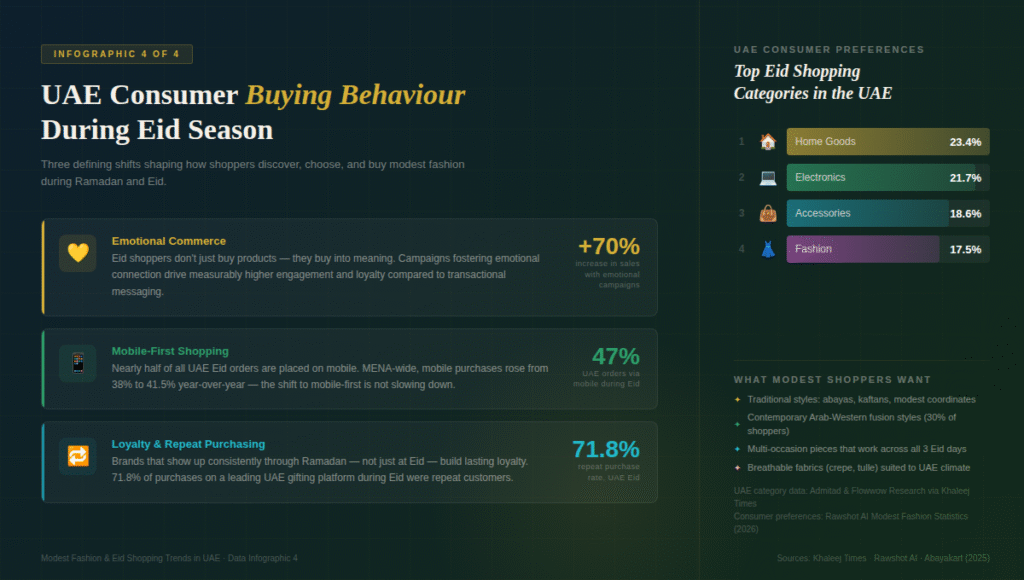
The first thing to understand is the shift toward emotional commerce. Consumers in the UAE aren’t just buying an outfit or a gift, they’re buying into a feeling.
The research is clear. A Google study found that shoppers often make decisions based on their emotions. Another study found that emotional marketing can boost sales and use of a product by 70%.
It has a direct effect on clothes that are not too revealing. How you dress for Eid is a big part of who you are. It’s a way to show off your family’s style and your own. When a woman in Dubai chooses her Eid outfit, she’s thinking about how she’ll feel at family gatherings, what will photograph well, and whether the piece feels meaningful. Brands that speak to that emotional layer, rather than just listing features and prices, consistently perform better during the season.
The second major behaviour shift is the move to mobile-first shopping. Mobile commerce was a key driver of growth during Eid, with 47 per cent of online orders in the UAE made via mobile devices. If your product pages aren’t optimised for mobile, your sizing guides aren’t mobile-friendly, or your checkout takes more than a few taps, you’re losing sales to a competitor who made those investments.
Third, the rise of repeat purchasing and brand loyalty is significant. During Eid Al Adha 2024, the share of repeat gift purchases on one major UAE gifting platform reached 71.8 per cent, reflecting growing customer loyalty. In fashion terms, this reinforces why building a consistent, recognisable modest fashion identity, not just a seasonal campaign, is what drives long-term growth.
Why are the Eid shopping trends in UAE so different from other markets?
A few reasons and understanding them are genuinely important for brands entering or expanding in this space.
For one, the UAE’s consumer base is uniquely multicultural. The modest fashion shopper here isn’t a monolithic demographic.
Across age groups, consumers desire more modest fashion options, catering to both traditional dress like abayas and kaftans and modest non-traditional clothing like non-form-fitting pieces. Additionally, around 30 per cent are specifically searching for contemporary Arab styles that blend local and Western fashion. (Source: Rawshot.ai)
The other factor is the UAE’s robust retail infrastructure. Dubai Mall becomes particularly vibrant during Eid, offering fashion, dining, and gifting options under one roof and for many shoppers, the in-store discovery experience is still an important part of how they find and decide on their Eid looks. This isn’t a market where online has completely replaced physical retail; the two work together.
What makes the Eid shopping trends in UAE distinct is also the sheer concentration of high-income consumers. Average order values in the UAE during Eid consistently rank among the highest in MENA, and there is a genuine appetite for premium modest fashion that combines quality craftsmanship with cultural relevance.
What’s happening with modest fashion influencer marketing, and how big a deal is it really?
Bigger than most brands realise, and it’s still growing.
The numbers around social media engagement during Ramadan and Eid are striking. The #modestfashion hashtag grew by 45 per cent in the UAE during Ramadan on Instagram, and that kind of organic spike in interest represents an enormous window for brands that have the right voices speaking for them.
On TikTok, the hashtag #modestfashion has crossed 1.3 billion views, driven largely by Gen Z and millennial creators who are reimagining what modest dressing looks like for a younger, style-forward audience.
(Source: Abayacart)
What’s changed isn’t just the volume of content; it’s the nature of the conversation. Modest fashion creators aren’t just showing outfits anymore. They’re doing deep dives into fabric quality, discussing how pieces hold up across a full day of Eid visits, comparing sizing across brands, and giving followers genuinely useful purchasing guidance.
The influencer space has also become more nuanced. Brands should put their trust in Muslim creatives who understand the nuances of modest dressing to curate Ramadan or Eid edits, as one industry analyst noted. The reasoning is practical: a creator who actually dresses modestly day-to-day understands what their audience needs from a garment, and that authenticity comes through.
The UAE has a thriving pool of these creators to work with. Harper’s Bazaar Arabia has identified UAE-based fashion influencers with over 800,000 Instagram followers who regularly top best-dressed lists within the modest fashion space. These aren’t niche accounts anymore, they’re mainstream style authorities whose Eid edits carry real commercial weight.
How should retail brands practically prepare for the Eid season?
Let’s get into the specifics, because this is where most brands drop the ball.
1. Start earlier than you think you need to
Eid shopping intent builds throughout Ramadan, not just in the final days. Luxury brands tend to shine during the last few days of Ramadan, but fashion discovery begins much earlier. Consumers are browsing, saving, and shortlisting, so your collection and your content need to be visible from the start of Ramadan, not just the week before Eid.
2. Build your influencer strategy around cultural alignment, not just follower counts
In the UAE and Kuwait, influencers must be licensed to run paid campaigns, and agencies ensure compliance by managing contracts, tax registration, and ad disclosure.
Beyond legal compliance, the brands doing influencer marketing well in this space are those who give creators genuine creative freedom rather than scripted briefs that feel out of step with their usual content.
3. Don’t overlook the full modest wardrobe, not just hero pieces.
Given that Eid shopping trends in UAE increasingly involve building multi-occasion wardrobes across the Eid days, brands that offer complete outfit solutions (including matching accessories, layering pieces, and coordinated sets) have a structural advantage over those selling standalone items.
4. Invest in your mobile experience
With nearly half of all UAE online orders placed on mobile during Eid, a clunky mobile experience is a direct revenue leak. This means fast-loading pages, clean product photography showing how garments move and drape, size guides that are easy to navigate on a small screen, and a checkout that doesn’t require unnecessary steps.
5. Lean into emotional storytelling
The brands winning during Eid in the UAE are moving away from transactional shop messaging and toward content rooted in cultural values and genuine connection. In response to consumer behaviour, brands are moving away from transactional messaging toward emotionally driven campaigns rooted in cultural values and storytelling.
For modest fashion specifically, this might look like a behind-the-scenes look at a designer’s Eid collection process, or a creator sharing how she styles a piece for different moments across the three days.
Is the global modest fashion market really big enough to invest in seriously?
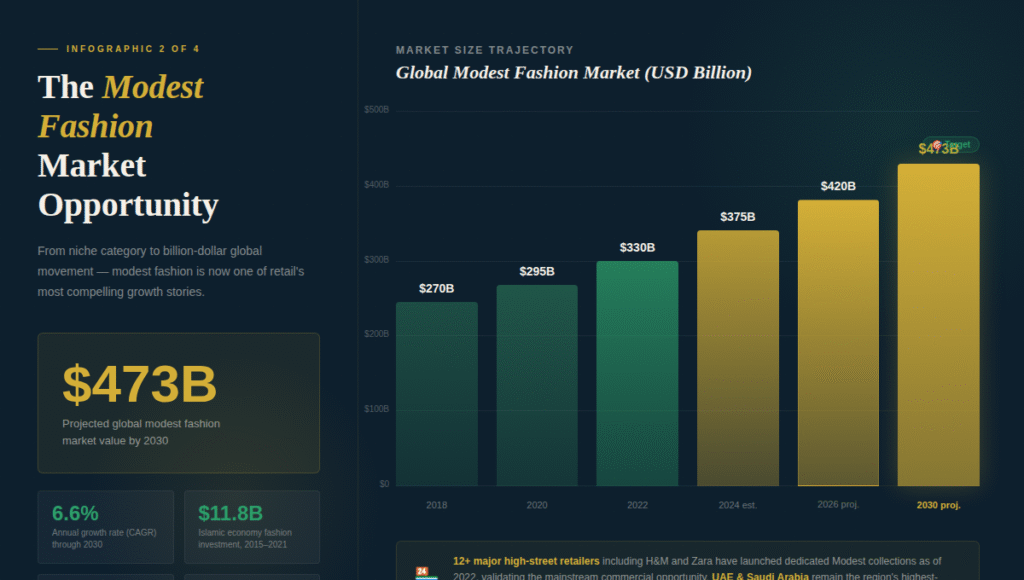
Short answer: yes, and the data makes a compelling case.
The global modest fashion market is projected to reach USD 473 billion by 2030, growing at an annual rate of 6.6 per cent. (Source: Abayacart) That’s not a niche category; that’s a major market segment that happens to peak hard during Ramadan and Eid seasons in markets like the UAE.
What’s driving it beyond demographics is something more fundamental: modest fashion has become a genuine aesthetic movement, not just a religious compliance category. Collaborations between local and international brands are multiplying, bringing authenticity and global exposure simultaneously.
International design houses are paying attention, and the industry is getting more competitive. This means that there is a real and valuable chance to position your brand early and authentically in the modest fashion market.
Knowing how people shop in the UAE around Eid is useful for more than just the weeks before it happens. It shows how Muslim buyers deal with trends, who they are, and shopping online in general. The way stores around the world do business is changing because of these patterns.
Final Thought
Today’s shoppers want fashion brands to know about different cultures, make them feel something, and be well-made. A great deal is what we can learn from how people in the UAE shop for Eid. Just selling simple clothes is not enough for businesses in the UAE. They must assist in creating the experience of it.
Companies that spend money on the right lines, work with real people, and show up for Ramadan and Eid will make money all year, not just during those times.
Curious to learn the process? Book a consultation with our experts now!