
The UAE has quietly become one of the most digitally active markets during Ramadan. And if you thought people slow down during the holy month, think again.
From suhoor snacks ordered at 2 AM to last-minute abayas added to carts after Taraweeh prayers, Ramadan online shopping in the UAE has its own rhythm, its own peak hours, and its own rules.
Let’s break it all down in a format that mirrors how most people are actually searching for this with straight-up questions and straight-up answers.
How do consumer preferences change for online shopping during Ramadan?
A great starting point, because the shift is more significant than most marketers realise.
During Ramadan, UAE consumers don’t just buy differently, they think differently about purchases. The month carries an emotional weight that transforms buying decisions. Generosity, family, community, and spirituality all influence what ends up in the cart.
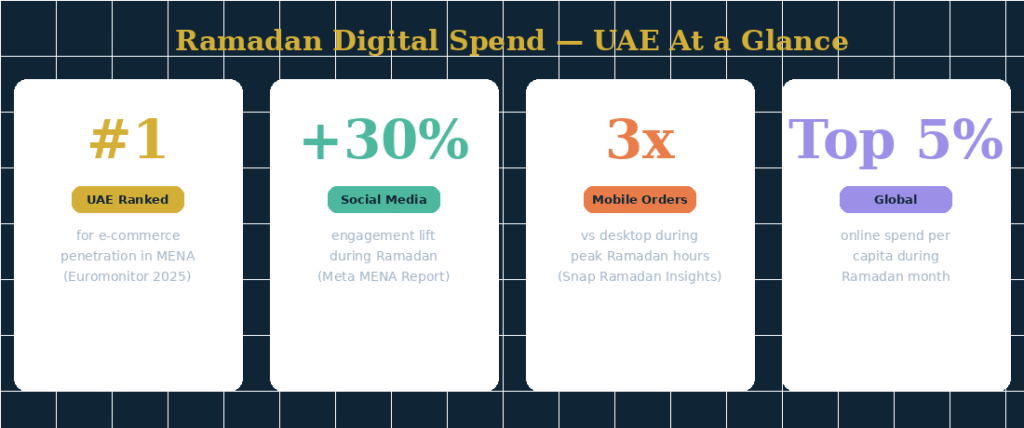
According to recent data, social media engagement in the UAE spikes during Ramadan compared to the rest of the year, and a huge chunk of that activity is product discovery.
People are browsing Instagram Reels of iftar table setups, saving TikTok’s of outfit ideas for Eid, and clicking through to purchase, all within the same session.
What changes most noticeably is the intent behind purchases. Shoppers shift from what do I need? to what can I give, share, or experience?! Gift sets, hampers, home décor, and family-sized food packs dominate Wishlist’s. The individual impulse buy gives way to communal and celebratory shopping.
Ramadan shopping Dubai also shows a clear pattern: brick-and-mortar traffic drops during daytime hours (fasting takes a toll), but online browsing surges, specially on mobile. Retailers who understand this flip their strategy entirely, pushing digital-first campaigns and ensuring their mobile UX is seamless during what are, frankly, odd hours by any other calendar’s standards.
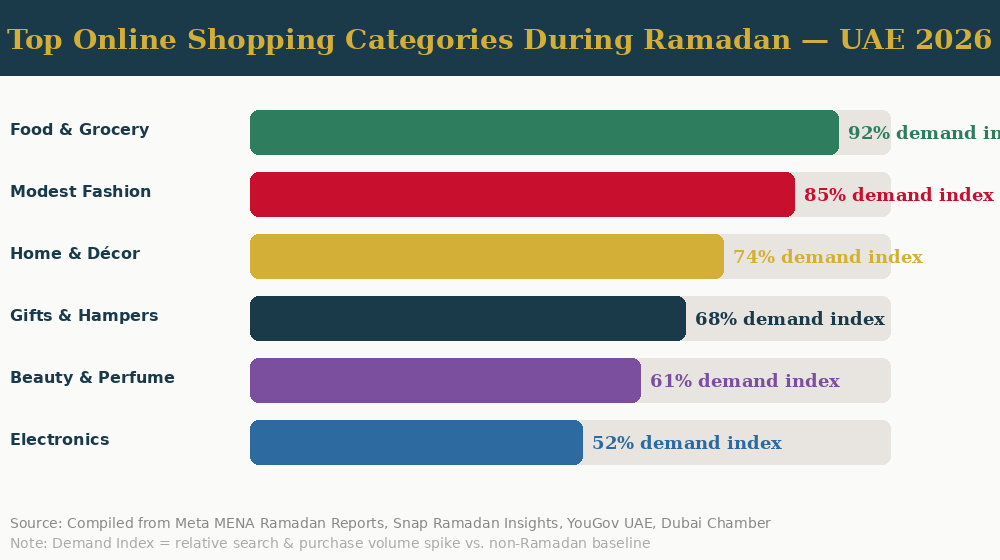
What are the top categories for online shopping spikes during Ramadan?
If you’re a brand wondering where to put your budget, here’s what the data consistently shows.
Food & Grocery tops the list every single year. With more home-cooked iftars and suhoor meals, grocery delivery platforms like Carrefour UAE, Noon Daily, and InstaShop see order volumes climb significantly.
According to Khaleej Times reporting on Ramadan online shopping habits, platforms in Dubai saw grocery delivery orders increase by over 40% during the holy month in recent years, with dates, lamb, fresh juice, and traditional sweets leading the charge.
Fashion & Modest Wear is a close second. This is where Ramadan offer for clothes come into full swing. Modest fashion, abayas, thobes, kaftans, and children’s Eid outfits fly off virtual shelves.
Platforms like Namshi, Ounass, and even global players like ASOS see Gulf-specific search terms spike dramatically. Searches for Ramadan offer for clothes hit their highest volume in the final 10 days of the month as Eid approaches.
Home & Living rounds out the top three. Think candles, lanterns, table runners, serving dishes, and decorative lighting. In the UAE, people spend a lot of time and money making their homes feel like Ramadan, and online markets make it easy to do this without leaving the house during fasting hours.
Personal care and beauty, electronics (evening entertainment picks up), and gift baskets are some other important areas. Ramadan Kareem shopping culture in the UAE places enormous value on presentation, so premium packaging, gift wrapping options, and branded hampers see a meaningful bump.
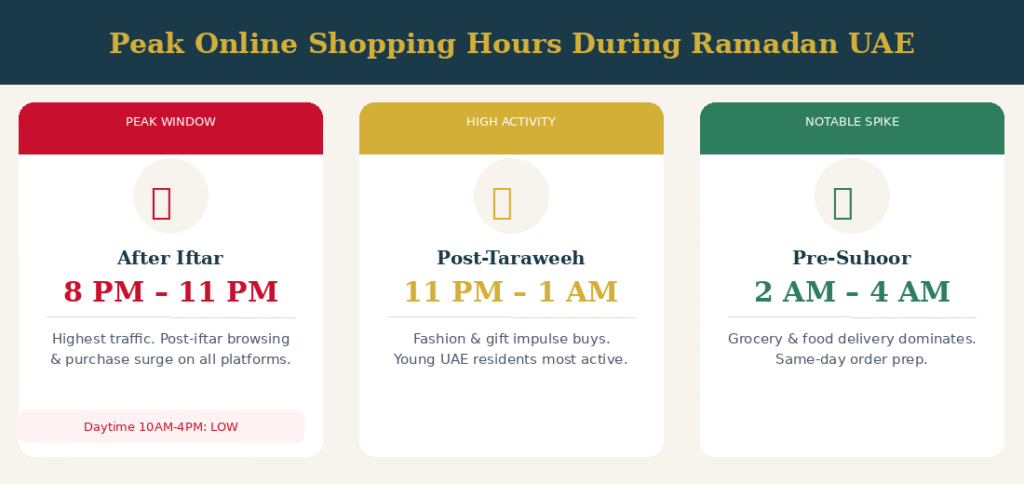
What are the peak online shopping times during Ramadan in the Middle East?
This one surprises most people outside the region, and it absolutely should inform your campaign scheduling.
Forget the 9-to-5. During Ramadan, the UAE operates on a completely different time curve.
Based on insights from Sila Insights‘ Ramadan consumer research and supported by data from Salesforce’s digital commerce benchmarks, the peak browsing and purchasing windows during Ramadan in the UAE cluster around three key times:
After Iftar (8 PM – 11 PM): The biggest window. Families have eaten, energy is restored, and people are relaxed at home with their phones. This is prime discovery and purchase time. Brands that schedule push notifications, email campaigns, or flash sales to land at 8:30 – 9:00 PM see significantly higher open rates than those sending during the day.
Post-Taraweeh (11 PM – 1 AM): A second, often underestimated peak. Late-night browsing is very real during Ramadan, specially among younger UAE residents. At this point, people often buy clothes on a whim or order gifts at the last minute.
Pre-Suhoor (2 AM – 4 AM): A small but significant rise has happened, especially for apps that bring food and groceries. At these times, most people are busy getting ready for the next fasting day or making orders for Suhoor.
Between 10 AM & 4 PM, daytime viewing slows down. Spreading out your ad budget throughout the day means you are wasting money at times when people are least likely to be interested in what you have to offer. Smart brands in Dubai’s Ramadan shopping move most of their digital marketing budgets to the hours after iftar and late at night.
What are the essential products people buy for Ramadan in the UAE?
Since food and fashion are too general to be of any value, let’s become more particular.
Based on publicly accessible reporting from sites like Noon, Carrefour UAE, and Amazon.ae during Ramadan seasons, the following is a summary of what really sells:
Dates (particularly high-quality Medjool and Ajwa types), mixed nuts, dried fruits, lamb and chicken pieces, premade meal kits for harees and machboos, fruit juices, and traditional Arabic sweets like qatayef and kunafa are all appropriate for the Iftar table.
People like to decorate their homes with prayer rugs, LED string lights, fanoos (Ramadan lanterns), beautiful moon and star trinkets, and Ramadan-themed tableware.
High-end attar and oud fragrances, skincare products, understated clothing, and opulent gift baskets are available for both personal use and giving. In order to shift seasonal fashion inventory, brands such as Centrepoint and Splash aggressively promote Ramadan online shopping incentives. Customers react favourably, particularly when free delivery or buy one, get one free offers are rendered.
For entertainment, as evenings get longer and more social, there is a surge in the use of gaming equipment, streaming device subscriptions, and Bluetooth speakers.
People are actively searching for both value and meaning in their purchases as they shop during Ramadan. A product that tells a story, locally made, charity-linked, artisanally packaged, tends to outperform a generic equivalent even at a higher price point.
How do online grocery shopping habits shift during Ramadan in the UAE?
This is where behavioural change is perhaps most dramatic and most measurable.
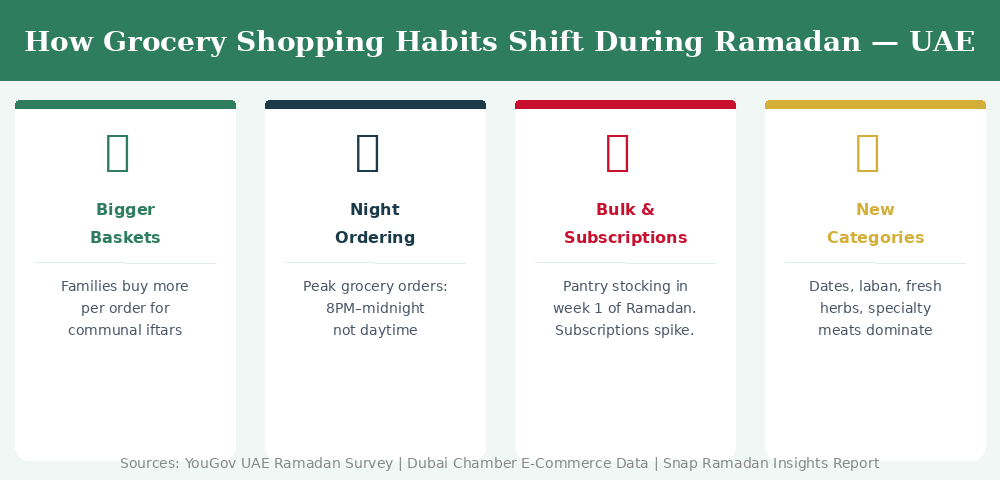
Grocery shopping in the UAE during Ramadan undergoes a structural shift in three key ways:
- Basket size grows, frequency increases. Families buy more per order and order more often. The communal nature of iftar means households are feeding more people, extended family, guests, and neighbours. Average order values on grocery platforms reportedly rise by 25–35% during Ramadan, according to platform-level data reported by Khaleej Times.
- Timing of orders shifts to late night. As covered above, UAE residents place grocery orders in the evening and late-night hours. Platforms that optimise their delivery slots for post-iftar pickups (8 PM – midnight) gain a real competitive edge. Same-day and next-morning delivery has become a key differentiator in this window.
- Category mix changes fundamentally. Typical weekly grocery staples are supplemented (and sometimes replaced) by Ramadan-specific items. Dates, laban, fresh herbs, speciality meats, and pre-made iftar items surge.
There are more subscriptions and big purchases. During the first week of Ramadan, more people sign up for subscriptions and buy in bulk on food shopping websites. This is because families are stocking their pantries for the whole 30 days.
During the first 72 hours of Ramadan, platforms that deliver organic and fresh food allegedly get some of the most new subscribers of the whole year.
The change can also be seen in how people look. According to HubSpot’s analysis of search trends, keywords like: iftar delivery Dubai, Ramadan grocery deals, and suhoor meal prep spike in the first week of Ramadan compared to baseline months.
Are Ramadan online shopping offers actually effective, or is it just noise?
The short answer: they work, but only when they’re relevant and well-timed. Generic discount codes slapped onto standard inventory don’t move the needle the way, but purpose-built Ramadan shopping offers do.
What the data shows and what Rewind’s consumer behaviour analysis for Dubai businesses echoes is that UAE shoppers during Ramadan respond most strongly to:
Bundled value over straight discounts. A gift hamper worth AED 350, now AED 249, outperforms a 30% off everything banner in most A/B tests during this period. The gift-giving context makes bundled offerings feel purposeful rather than promotional.
Free delivery as a conversion driver. During Ramadan, free delivery is almost table stakes for competitive categories. With late-night orders being common, the friction of a delivery fee at checkout is enough to cause abandonment.
Flash sales timed to post-iftar peaks. When brands have two-hour flash sales between 9 PM and 11 PM, specially in the last two weeks before Eid, when preparations are really heating up, the conversion rates are much higher than with regular discounts.
Messages tailored to each area. As a greeting, “Ramadan Kareem” shows that you know about the customs of the locals.
The UAE’s online shopping system benefits businesses that are sensitive to Ramadan. It is not only about the deal, but also about how it was put together.
One last thought, what should brands do with this?
Understanding Ramadan online shopping behaviour in the UAE isn’t just an academic exercise; it’s a commercial imperative for any brand operating in this market. The consumers are active, their intent is high, and their spending is real. But they’re also culturally attuned and quick to notice inauthenticity.
The playbook is cleaner than it might seem: show up during the right hours, offer genuinely relevant products and Ramadan online shopping offers, speak the cultural language without overdoing it, and make the mobile experience frictionless.
Do those four things well, and the UAE’s Ramadan consumer will reward you often generously, because generosity is, after all, the spirit of the month.
Contact our specialists at Blue Tangerine today to start your Ramadan marketing!